
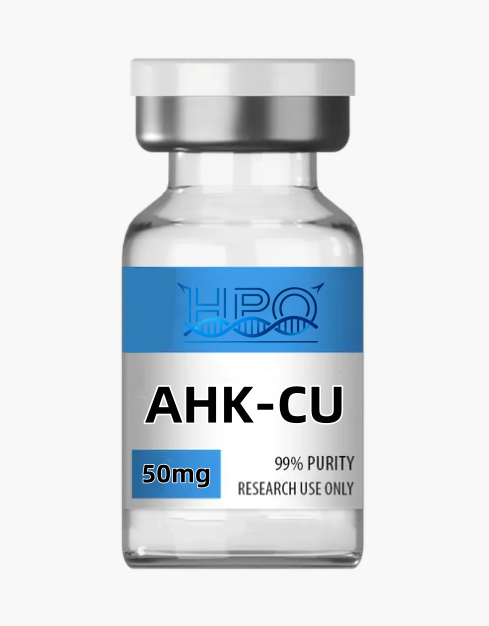
AHK-CU
Original price was: $50.00.$45.00Current price is: $45.00.
AHK-Cu is an Ala-His-Lys copper tripeptide supplied for controlled laboratory research into copper coordination, dermal papilla cell biology and analytical behavior. Research use only; not for human or animal consumption.
DISCLAIMER:
AHK-Cu Peptide: Copper Tripeptide Research Guide
AHK-Cu peptide is a copper-coordinated tripeptide research material based on the amino-acid sequence L-alanyl-L-histidyl-L-lysine (Ala-His-Lys). It is investigated primarily in laboratory models involving copper-peptide coordination, dermal papilla cell biology, fibroblast signaling, extracellular-matrix responses, and ex-vivo hair-follicle behavior. Hanpro Peptides supplies AHK-Cu as a lyophilized material for analytical, in-vitro, and appropriately authorized preclinical research only. It is not a medicine, cosmetic finished product, dietary supplement, or material for human or animal consumption.
AHK-Cu should be treated as a defined research reagent rather than as a claim of hair restoration or tissue repair. The most directly relevant published study evaluated human hair follicles ex vivo and cultured dermal papilla cells in vitro. Those findings support specific mechanistic hypotheses, but they do not establish efficacy, dosing, safety, or clinical performance in people. Results depend on peptide identity, copper coordination state, concentration, matrix composition, cell source, exposure time, and assay design.
Identity and chemical characteristics
| Product name | AHK-Cu peptide |
|---|---|
| Peptide sequence | Ala-His-Lys (AHK) |
| Full peptide name | L-alanyl-L-histidyl-L-lysine |
| Complex | AHK coordinated with copper(II) |
| Free-peptide molecular mass | Approximately 354.4 g/mol; the copper complex mass depends on coordination, counterions, and hydration state |
| Physical form | Lyophilized research material |
| Analytical review | Lot-specific HPLC/UPLC and mass-spectrometric documentation |
| Intended use | Laboratory research and analytical development only |
AHK contains an N-terminal alanine, a histidine residue with an imidazole side chain, and a C-terminal lysine. The N-terminal amine, peptide nitrogens, and histidine imidazole can participate in copper binding. Exact species distribution may change with pH, ionic strength, competing ligands, and buffer composition. For that reason, researchers should not infer a single coordination geometry under every experimental condition. The certificate of analysis and the receiving laboratory’s own method should be used to confirm the form under study.
What research has examined AHK-Cu?
Human hair-follicle explant models
A 2007 study evaluated L-alanyl-L-histidyl-L-lysine-Cu2+ in isolated human hair follicles and cultured dermal papilla cells. In that experimental system, AHK-Cu was associated with follicle elongation across selected low-molar concentration ranges. An ex-vivo follicle is useful because it preserves some tissue architecture, but it remains outside the living organism and cannot reproduce systemic exposure, metabolism, immune responses, or long-term safety.
Dermal papilla cell proliferation
Dermal papilla cells are specialized mesenchymal cells located at the base of the hair follicle and contribute to follicle morphogenesis and cycling. The same study reported increased proliferation of cultured dermal papilla cells after AHK-Cu exposure. A robust replication should include vehicle controls, untreated controls, multiple donors, pre-specified time points, direct cell counts, and viability measurements so that changes in metabolic-assay signal are not automatically interpreted as increased cell number.
Apoptosis-associated markers
Researchers also examined Annexin V/propidium iodide labeling and proteins associated with apoptosis, including Bcl-2, Bax, cleaved caspase-3, and PARP. The reported reduction in apoptotic cell number was not statistically significant in one analysis, although several protein readouts shifted in a direction consistent with altered survival signaling. This distinction matters: an exploratory molecular change is not equivalent to proof of a durable biological or clinical effect.
Fibroblast and growth-factor hypotheses
The AHK-Cu literature is smaller than the literature for the related GHK-Cu copper peptide. Published background work has discussed copper-tripeptide effects on differentiated cells, dermal fibroblast proliferation, vascular endothelial growth factor, and transforming growth factor beta signaling. These observations can guide endpoint selection, but evidence obtained with GHK-Cu should not be assigned to AHK-Cu without direct testing because replacing the N-terminal glycine with alanine may influence coordination, transport, stability, and biological interactions.
Mechanistic questions for laboratory study
1. Copper coordination and speciation
Copper is redox active and can interact with proteins, amino acids, chelators, and vessel surfaces. AHK-Cu experiments should document pH, buffer identity, metal-to-ligand ratio, incubation time, and competing species. UV-visible spectroscopy, circular dichroism, electron paramagnetic resonance, or mass spectrometry may be useful depending on the research question. A clear blue color is not sufficient evidence of identity, purity, or a single coordination state.
2. Concentration-response behavior
Use a broad pilot range selected for the model, then establish a narrower concentration-response curve. Include the unconjugated AHK ligand, an appropriate copper control, vehicle, and the intact AHK-Cu complex where feasible. These arms help distinguish peptide-sequence effects from copper effects and from behavior unique to the coordinated complex.
3. Cell proliferation versus cytotoxicity
Pair proliferation endpoints with membrane-integrity, apoptosis, and metabolic-viability assays. Copper-containing complexes can produce different responses in serum-free and serum-containing media, and an apparent decrease in assay signal may reflect interference rather than toxicity. Orthogonal methods and blank wells containing reagent without cells are important controls.
4. Extracellular-matrix readouts
Investigators may quantify collagen-associated transcripts, matrix metalloproteinases, tissue inhibitors of metalloproteinases, migration, or extracellular deposition. These endpoints should be normalized to viable cell number and interpreted within the selected cell type. A change in a marker does not by itself demonstrate organized matrix formation or tissue repair.
5. Donor and passage effects
Primary dermal papilla cells may vary by donor, anatomical source, age, passage number, and culture conditions. Record these factors and use biological replicates. Where possible, analyze donor as a random effect rather than pooling all measurements as though they were independent.
Suggested experimental controls
- Vehicle control: matches solvent, buffer, and handling without peptide.
- AHK ligand control: helps separate peptide effects from those of the copper complex.
- Copper control: uses a justified copper species at an analytically relevant concentration.
- Reference copper peptide: a separately characterized GHK-Cu arm may support comparative studies.
- Positive and negative biological controls: selected for the endpoint rather than copied from an unrelated assay.
- Cell-free interference controls: identify optical or chemical interaction with colorimetric and fluorescent reagents.
- Time-zero and stability samples: track chemical change during the experimental window.
Analytical quality and method development
Confirm identity and purity with lot-appropriate methods. Reversed-phase HPLC or UPLC can characterize peptide-related species, while LC-MS can support molecular identity. Because metal coordination may influence ionization and chromatographic behavior, method suitability should be demonstrated with relevant controls. If the study depends on copper occupancy or free copper, add a validated metal-analysis or speciation method rather than relying solely on peptide-area percentage.
Chromatographic purity, peptide content, copper content, water, counterions, residual solvents, and bioburden are different attributes. A single percentage cannot substitute for a complete specification. Researchers should retain the lot COA, record receipt and storage history, and independently verify critical attributes when required by the experimental design.
Handling and stability considerations
Store unopened material according to the product label and lot-specific COA, protected from moisture and unnecessary light exposure. Allow a sealed vial to equilibrate before opening when condensation is a concern. For solution studies, determine compatibility with the intended solvent, buffer, pH, container, and analytical method before preparing the full experiment.
Strong chelators and competing ligands can alter copper coordination. Proteins and amino acids in culture media may also redistribute copper or change apparent availability. Prepare only the quantity needed for a validated laboratory protocol, document preparation time and appearance, use suitable low-binding containers when justified, and minimize repeated freeze-thaw cycles through aliquoting. Stability after preparation must be established for the actual matrix and temperature; no universal solution-stability period should be assumed.
Frequently asked questions
What does AHK-Cu stand for?
AHK refers to the amino-acid sequence alanine-histidine-lysine. AHK-Cu is the copper(II)-coordinated form studied as a small copper tripeptide research complex.
Is AHK-Cu the same as GHK-Cu?
No. GHK-Cu contains glycine-histidine-lysine, whereas AHK-Cu contains alanine-histidine-lysine. They are related copper tripeptides, but the sequence difference means identity, coordination behavior, stability, and biological observations should be evaluated separately.
Does AHK-Cu regrow hair?
The direct evidence commonly cited comes from ex-vivo human hair follicles and cultured dermal papilla cells. Those models support laboratory hypotheses but do not prove clinical hair regrowth, establish a treatment protocol, or demonstrate safety in humans.
What concentration should be used?
Hanpro Peptides does not provide human or animal dosing instructions. Laboratory concentrations should be selected from relevant literature, preliminary range-finding, assay sensitivity, and institutional protocols, with appropriate vehicle, copper, ligand, and viability controls.
How should AHK-Cu identity be confirmed?
Use the lot-specific COA and fit-for-purpose analytical methods such as HPLC/UPLC and mass spectrometry. Studies focused on metal occupancy or coordination may also require spectroscopy or elemental analysis.
Can AHK-Cu be mixed with other peptides?
Only within a justified research design after compatibility testing. Other peptides, buffers, chelators, and proteins may compete for copper or alter stability. Separate single-component controls are necessary before interpreting any combined response.
Is this product approved for clinical or cosmetic use?
No. This material is sold solely for lawful laboratory research and analytical work. It is not FDA-approved to diagnose, treat, cure, or prevent disease and is not intended for human or animal consumption or direct cosmetic application.
Related research products
- GHK-Cu – a related Gly-His-Lys copper complex.
- GHK-Cu + KPV Blend – a two-component copper-peptide research formulation.
- KPV – a Lys-Pro-Val tripeptide research material.
- GLOW Blend – a multi-component formulation for comparative research.
- BPC-157 – a separate peptide for preclinical tissue-response studies.
- TB500 – a thymosin-beta-4-related research product.
- Cartalax – an Ala-Glu-Asp tripeptide research material.
- Vilon – a Lys-Glu dipeptide research material.
Selected research references
- Pyo HK, et al. The effect of tripeptide-copper complex on human hair growth in vitro. Arch Pharm Res. 2007;30(7):834-839. PMID: 17703734.
- Laussac JP, Haran R, Sarkar B. NMR and EPR investigation of the interaction of copper(II) and glycyl-L-histidyl-L-lysine. Biochem J. 1983;209:533-539. PMID: 6303307.
- Lau SJ, Sarkar B. The interaction of copper(II) and glycyl-L-histidyl-L-lysine. Biochem J. 1981;199:649-656. PMID: 7340824.
- Gonzalez P, et al. Cu(II) Binding to the Peptide Ala-His-His. Inorg Chem. 2017;56:14870-14879. PMID: 29190078. Included as coordination-chemistry context, not as AHK-Cu efficacy evidence.
Research-use disclaimer
AHK-Cu is supplied for laboratory research and analytical purposes only. It is not for human or animal consumption, self-administration, diagnosis, treatment, or prevention of disease. It has not been evaluated or approved by the FDA for therapeutic use. The purchaser and investigator are responsible for lawful procurement, qualified handling, institutional oversight, appropriate controls, and disposal in accordance with applicable requirements.
| Specification | 50mg*10vials |
|---|
Only logged in customers who have purchased this product may leave a review.
Related products
Reviews
There are no reviews yet.