
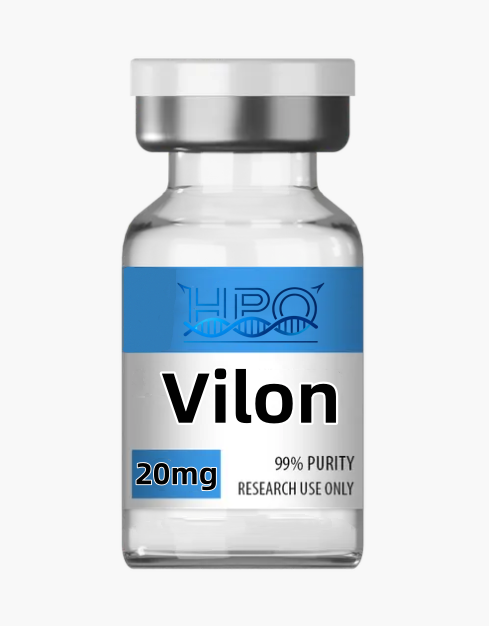
Vilon
$150.00
Vilon is the Lys-Glu (KE) dipeptide used in laboratory studies of thymic-cell models, small-peptide analytics and structure–activity relationships. Review lot-specific identity and quality; research use only.
DISCLAIMER:
Vilon Peptide Research Guide: Lys-Glu Identity, Evidence and Study Design
Vilon peptide is a short research compound composed of L-lysine followed by L-glutamic acid. It is also described as L-lysyl-L-glutamic acid, Lys-Glu, KE or H-Lys-Glu-OH. Because it contains only two amino-acid residues, Vilon provides a compact model for investigating how sequence, charge, stereochemistry, transport and cellular context influence the activity reported for small peptides.
Published Vilon literature is limited and is concentrated in older in vitro and animal studies, with some papers available only as English abstracts of Russian-language articles. Several experiments examined thymic cells, lymphocyte differentiation, stress models or age-associated tissue changes. These findings are useful for hypothesis generation, but they do not establish clinical efficacy, an anti-aging effect or suitability for human use. This catalog material is supplied strictly for controlled laboratory research.
Chemical identity and reference properties
| Property | Research reference |
|---|---|
| Common name | Vilon |
| Chemical name | L-lysyl-L-glutamic acid |
| Sequence | Lys-Glu (KE; H-Lys-Glu-OH) |
| CAS Registry Number | 45234-02-4 |
| PubChem CID | 7010502 |
| Molecular formula | C₁₁H₂₁N₃O₅ |
| Molecular weight | 275.30 g/mol |
| Structure class | Linear dipeptide |
| Catalog purpose | Laboratory research only |
The lysine residue contributes an additional basic side-chain amino group, while glutamic acid contributes an acidic side-chain carboxyl group. Their protonation states vary with pH, so net charge, solubility, chromatographic retention and interactions with membranes or proteins can change across buffers. Researchers should report pH, ionic strength and counterion composition when comparing experiments.
Sequence notation matters. Vilon is Lys-Glu, not Glu-Lys, Lys-Asp or Glu-Trp. Those dipeptides have different structures and cannot be treated as synonyms or interchangeable controls. Analytical identity should distinguish the intended sequence from isomers, free amino acids and synthesis-related impurities.
What the published evidence does—and does not—show
Thymic cell culture observations
A 2013 study evaluated Vilon, identified in the paper as dipeptide AB-O, in cultured human and rat thymic cells. The authors reported changes in CD5 expression and differentiation-related markers, including a shift toward CD4-positive T-helper phenotypes. The work supports investigation of thymic-cell responses, but it does not by itself identify a single molecular receptor, demonstrate organism-wide immune benefit or prove a therapeutic effect.
Thymus and spleen in an animal radiation model
An earlier rat study used low-dose ionizing radiation as a model of premature tissue aging and reported that Vilon partly inhibited measured changes in the thymus and spleen. Interpretation should remain tied to that experimental model. Radiation exposure, species, tissue collection time and histological scoring are important variables, and a result in irradiated rats cannot be generalized to normal aging or human treatment.
Stress-model findings
Another rat study examined open-field behavior, c-Fos immunoreactivity in the paraventricular hypothalamus, adrenal and thymic morphology, and plasma albumin. Reported differences after Vilon exposure provide possible endpoints for replication. They do not establish a validated stress treatment, and behavioral results require careful attention to baseline phenotype, handling, blinding and multiple-comparison control.
Fibroblast marker research
An in vitro study of human skin fibroblasts reported changes in immunofluorescence areas for collagen I and SIRT6 after exposure to KE dipeptide. Such marker changes may support cell-biology questions about expression or localization. They are not evidence that a research reagent reverses skin aging in people, and they do not establish cosmetic safety, penetration or performance.
Important uncertainty
Many mechanistic claims repeated online—such as direct chromatin binding, selective gene activation or broad “bioregulation”—are not established simply by the compound’s short sequence. A credible mechanism requires target engagement, concentration dependence, appropriate negative controls, independent replication and an explanation that fits exposure at the site of action. Until those elements are shown, pathway language should remain hypothesis-based.
Research questions suited to Vilon peptide
1. Dipeptide identity and analytical characterization
Vilon can be used as a compact target for liquid chromatography and mass-spectrometry method development. Researchers can examine retention behavior, ionization, fragmentation, recovery and separation from free lysine, free glutamate, sequence isomers and degradation products. Because the molecule is small and polar, sample preparation and column chemistry can strongly affect results.
2. Thymic-cell differentiation models
Published observations suggest testing CD5, CD4 and CD8-related endpoints in defined thymic cell systems. Experiments should document species, donor source, cell isolation, viability, culture duration, serum conditions and antibody panels. Flow-cytometry compensation, gating and blinded analysis are critical. A receptor-null or unrelated-dipeptide control can help distinguish sequence-specific effects from nonspecific nutrient or osmolarity effects.
3. Cytokine and immune-signaling assays
Earlier thymic peptide literature discussed cyclic nucleotides and cytokines, but Vilon-specific attribution should be tested rather than assumed. Multiplex cytokine results need prespecified analytes, normalization, detection-limit handling and correction for multiple testing. Orthogonal confirmation at RNA and protein levels can reduce the risk of interpreting assay noise as a pathway effect.
4. Cellular aging and stress-response models
Cell models can measure proliferation, viability, senescence-associated markers, DNA-damage responses, oxidative-stress endpoints and protein expression. Vilon should be compared with vehicle, constituent amino acids, an unrelated dipeptide and a validated positive control. A marker change alone is not equivalent to slower organismal aging; researchers should define the biological question and avoid broad geroprotective conclusions.
5. Transport and stability studies
Short peptides may be affected by extracellular and intracellular peptidases, transporters and rapid distribution. Useful experiments include time-resolved stability in buffer, medium or matrix; recovery from plastic and glass; and targeted measurement of intact Lys-Glu versus free amino acids. These data help determine whether observed cellular responses are associated with intact Vilon or breakdown products.
6. Structure–activity comparisons
A rigorous series can compare Lys-Glu with Glu-Lys, D-amino-acid analogs, N- or C-terminal modifications, constituent amino acids and sequence-matched purity controls. Such designs can test whether stereochemistry, order, termini or charge is important. All comparators should be characterized independently so that purity differences do not masquerade as structure–activity relationships.
Experimental design and controls
Begin with a defined primary endpoint and an assay-specific concentration range supported by preliminary cytotoxicity and solubility checks. Use biological replicates rather than relying only on repeated wells from one preparation. Randomize sample order where practical, blind image or flow analysis and document exclusion criteria before reviewing outcomes.
- Vehicle control: matches buffer, pH, salts and counterions.
- Positive control: demonstrates that the selected biological readout can respond.
- Sequence control: an unrelated or reversed dipeptide helps test sequence specificity.
- Constituent control: free lysine plus free glutamate tests whether hydrolysis products explain the effect.
- Viability control: separates signaling changes from loss of cells or metabolic suppression.
- Orthogonal readout: confirms a finding using a different analytical principle.
Report the actual lot, stock preparation, working concentration, exposure time, cell density and statistical model. If multiple markers or time points are screened, distinguish exploratory findings from preregistered confirmatory analyses. Small studies and unblinded scoring can overestimate effects, particularly when many endpoints are available.
Lot-specific quality review
Do not infer a fixed purity, content, sterility status, endotoxin value or shelf life from a generic web description. Review the certificate of analysis for the supplied lot. For quantitative work, net peptide content is different from chromatographic area purity and from gross vial mass.
Depending on the experiment, relevant documentation may include:
- identity by mass spectrometry and chromatographic retention;
- purity by a stated HPLC or UHPLC method;
- water, counterion and residual-solvent information;
- net peptide content or assay value;
- related substances, free amino acids and sequence-isomer controls;
- bioburden, endotoxin or sterility only when specifically tested;
- batch number, storage conditions and traceability records.
For this 275.30 g/mol compound, concentration calculations should use the mass basis stated on the lot document. When counterions or water contribute to powder mass, weighing the powder and assuming 100% Vilon can produce a systematic concentration error.
Handling and storage principles
Follow the product label and batch documentation. Keep the container sealed, dry and protected from unnecessary light and temperature cycling. Allow a cold sealed vial to equilibrate before opening to reduce condensation. Choose a buffer based on the analytical or biological assay, considering pH, ionic strength, compatibility and microbial-control requirements.
Establish solution stability under the exact working conditions rather than relying on a universal timeframe. Assess intact Vilon and relevant degradation products when stability affects interpretation. Use suitable laboratory containment and disposal procedures. This page intentionally does not provide administration, injection, self-use or clinical dosing instructions.
Frequently asked questions
What is Vilon peptide?
Vilon is the linear dipeptide L-lysyl-L-glutamic acid, abbreviated Lys-Glu or KE. PubChem lists CAS 45234-02-4, formula C₁₁H₂₁N₃O₅ and molecular weight 275.30 g/mol.
Is Vilon the same as other thymic dipeptides?
No. Sequence order and amino-acid identity define a dipeptide. Glu-Trp, Lys-Asp and Glu-Lys are chemically distinct and should not be substituted for Lys-Glu without a specific comparative design.
What mechanism has been established?
Cell and animal studies report changes in selected immune, tissue and stress-related endpoints, but a single validated molecular target has not been established by the limited literature. Mechanistic claims need target-engagement and sequence-specific controls.
Does Vilon have proven anti-aging or therapeutic effects?
No clinical benefit should be inferred from the available in vitro and animal reports. These studies support research questions, not claims of disease treatment, rejuvenation or improved lifespan in humans.
What controls are useful?
Vehicle, positive, reversed-sequence or unrelated-dipeptide controls, free lysine plus glutamate, viability measurements and orthogonal analytical readouts can improve interpretation.
How should concentration be calculated?
Use the lot-specific net peptide content and the molecular mass basis stated in the certificate. Do not treat chromatographic purity or gross powder mass as equivalent to active peptide content.
Is this product intended for human or veterinary use?
No. It is a laboratory research material only. It is not supplied for consumption, injection, diagnosis, treatment, veterinary use or cosmetic application.
Related research materials
Comparative peptide programs may also review Thymalin, Thymosin Alpha-1, Epithalon, Pinealon, Cartalax, Humanin, MOTS-c and SS-31. Each has a different sequence, evidence base and proposed research context; none should be treated as a direct substitute for Vilon.
Selected references
- PubChem. Lysylglutamic acid compound summary, CID 7010502.
- Sevostianova NN, et al. Immunomodulating effects of Vilon and its analogue in cultured human and animal thymus cells.
- Kniaz’kin IV, Polyakova VO. Effect of Vilon on thymus and spleen in a radiation model.
- Koplik EV, et al. Effect of dipeptide Vilon in a rat emotional-stress model.
- Morozov VG, Khavinson VK. Natural and synthetic thymic peptides and immune-dysfunction research.
- KE dipeptide study in human skin fibroblast cultures.
Research use only. Not for human or veterinary use, diagnosis, treatment, prevention, food, cosmetic or household applications. Researchers are responsible for institutional review, risk assessment and compliance with applicable laws and policies.
| Specification | 20mg*10vials |
|---|
Only logged in customers who have purchased this product may leave a review.
Related products
Reviews
There are no reviews yet.