
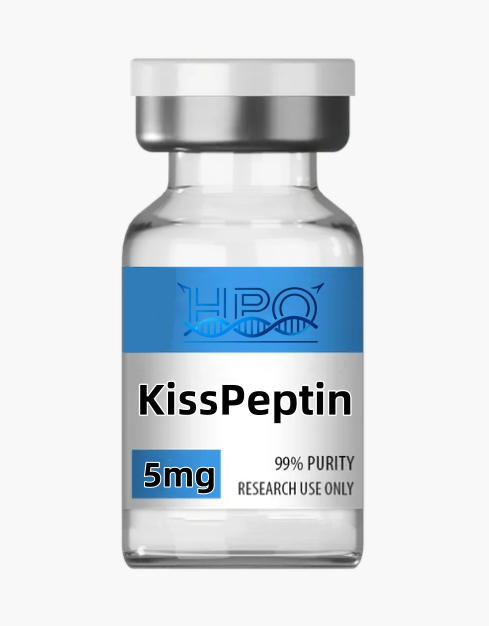
KissPeptin
Price range: $60.00 through $110.00
Kisspeptin research peptide guide for fragment identity, KISS1R signaling assays, analytical verification, handling, and batch comparability. For laboratory research use only.
DISCLAIMER:
Kisspeptin Research Peptide: Fragment Identity and KISS1R Assay Guide
Kisspeptin research peptide materials are used to investigate signaling through the KISS1 receptor (KISS1R, historically called GPR54). “Kisspeptin” is a family name, not one unique molecular entity: the human KISS1 precursor is processed into bioactive fragments commonly described as kisspeptin-54, -14, -13, and -10. Researchers should therefore confirm the exact fragment, species, sequence, terminal modification, counterion, and lot-specific analytical results before designing an experiment.
This distinction is essential for reproducibility. A vial labeled only “Kisspeptin” does not by itself establish whether the material is KP-10 or KP-54, and data from different fragments should not be pooled without a justified bridging study.
Identity of Kisspeptin Fragments
Reviewed human protein records identify KISS1 as the precursor for several cleaved kisspeptin chains. The fragments share a conserved C-terminal region and act as ligands for KISS1R. For human kisspeptin-10, the commonly reported amidated sequence is YNWNSFGLRF-NH2. This is the complete decapeptide; “NW-NH2” is not a valid representation of KP-10.
- KP-54: a 54-residue human fragment also known as metastin in some cancer-biology literature.
- KP-14 and KP-13: shorter processed fragments retaining the active C-terminal motif.
- KP-10: the C-terminal decapeptide frequently used in receptor-binding and cell-signaling assays.
Sequence numbering, precursor length, and fragment nomenclature can vary between species and publications. Record the organism and accession used as the reference sequence.
KISS1R Signaling Context
KISS1R is a G-protein-coupled receptor. Curated human protein information links kisspeptin binding with Gq-dependent signaling, phospholipase C activation, phosphatidylinositol 4,5-bisphosphate hydrolysis, and downstream calcium-related responses. The KISS1/KISS1R system is also widely studied in the hypothalamic-pituitary-gonadal axis through its regulation of gonadotropin-releasing hormone neurons.
These pathway descriptions provide assay hypotheses, not guaranteed outcomes for every cell line or lot. Receptor abundance, coupling efficiency, passage number, serum conditions, peptide degradation, exposure time, and readout timing can all affect the observed response.
Recommended Identity and Quality Checks
- COA review: confirm fragment name, amino-acid sequence, terminal amidation, counterion, lot number, and test date.
- Mass confirmation: compare observed intact mass with the theoretical value for the declared sequence and modification.
- Chromatographic purity: review the HPLC or UHPLC method, chromatogram, detection wavelength, and integration criteria rather than relying on a percentage alone.
- Peptide content: distinguish chromatographic purity from net peptide content and total vial fill.
- Water and counterion: account for moisture and salts when preparing molar concentrations.
- Endotoxin or bioburden: verify only when relevant to the selected biological system and use method-suitability controls.
For quantitative studies, calculate concentration from the lot-specific molecular form and peptide content. Nominal milligrams alone may overstate the amount of active peptide in a salt-containing or hydrated material.
Cell-Based KISS1R Assay Design
A receptor-focused study should establish that the test system expresses functional KISS1R. Common experimental approaches include calcium mobilization, inositol phosphate accumulation, reporter assays, receptor internalization, or downstream phosphorylation readouts. Select the endpoint according to the pathway question and validate the assay window before comparing lots or analogs.
- Include vehicle-only and untreated controls.
- Use a concentration-response series rather than one concentration.
- Include a known KISS1R agonist reference when appropriate.
- Use receptor-negative cells, knockdown, knockout, or a justified antagonist control to assess specificity.
- Match solvent, incubation time, cell density, passage number, and plate handling.
- Run technical replicates and independent biological repeats.
- Monitor nonspecific cytotoxicity or assay interference at high concentrations.
If comparing KP-10 with KP-54 or a modified analog, treat each as a distinct test article. Differences in stability, nonspecific binding, and apparent potency may reflect format and assay conditions as well as receptor pharmacology.
Reconstitution and Handling
Follow the lot-specific documentation as the primary instruction. Select a solvent and buffer compatible with the declared fragment and the downstream assay. Document pH, concentration, mixing method, container material, and time between preparation and measurement.
Use low-binding consumables when adsorption could affect recovery at low concentrations. Prepare small aliquots to minimize freeze-thaw cycles. Do not assume a universal refrigerated or frozen shelf life: solution stability depends on sequence, concentration, buffer, temperature, container, and analytical endpoint. A time-course stability experiment is preferable when measurements span multiple days.
Common Sources of Experimental Error
- Using “kisspeptin” without specifying KP-10, KP-54, or another fragment.
- Entering an incomplete or incorrect KP-10 sequence in study records.
- Ignoring C-terminal amidation when calculating theoretical mass.
- Confusing precursor-protein mass with mature-fragment mass.
- Calculating molarity from nominal fill without correcting for peptide content.
- Attributing calcium or reporter changes to KISS1R without specificity controls.
- Combining results from different species, fragments, or lots without qualification.
Batch-to-Batch Comparability
- Archive the COA and retain a reference aliquot from each lot.
- Run old and new lots in the same chromatographic or mass-spectrometric sequence.
- Compare intact mass, principal-peak profile, peptide content, and relevant impurities.
- Bridge lots in the same validated KISS1R assay using predefined acceptance criteria.
- Document any change in counterion, solvent, handling, or storage history.
Frequently Asked Questions
Is Kisspeptin one peptide?
No. The name covers multiple KISS1-derived fragments, including KP-54, KP-14, KP-13, and KP-10. Always verify the supplied fragment.
What is the human KP-10 sequence?
The commonly reported amidated human kisspeptin-10 sequence is YNWNSFGLRF-NH2. Confirm this against the product COA and reference accession used in the study.
Are KP-10 and KP-54 interchangeable?
No. Both can activate KISS1R, but they differ in length and may behave differently in stability, recovery, and time-dependent assays. Direct comparison requires matched conditions.
Which assay proves KISS1R activity?
No single assay proves specificity on its own. Combine a pathway-appropriate readout with receptor-expression evidence and a receptor-negative, genetic, or pharmacological specificity control.
Selected Reference Resources
- UniProtKB Q15726: human KISS1 — reviewed precursor, processed fragments, sequence, and functional annotations.
- NCBI Gene: human KISS1R — curated receptor nomenclature and reference-sequence information.
- KISS1-to-kisspeptin nomenclature review — explains fragment and receptor naming conventions.
Research Use Only
For laboratory research use only. Not for human or veterinary use, food, cosmetic use, clinical diagnosis, fertility treatment, or self-administration. Researchers are responsible for verifying identity, suitability, and institutional requirements before use.
| Specification | 5mg*10vials, 10mg*10vials |
|---|
Only logged in customers who have purchased this product may leave a review.
Related products

Reviews
There are no reviews yet.